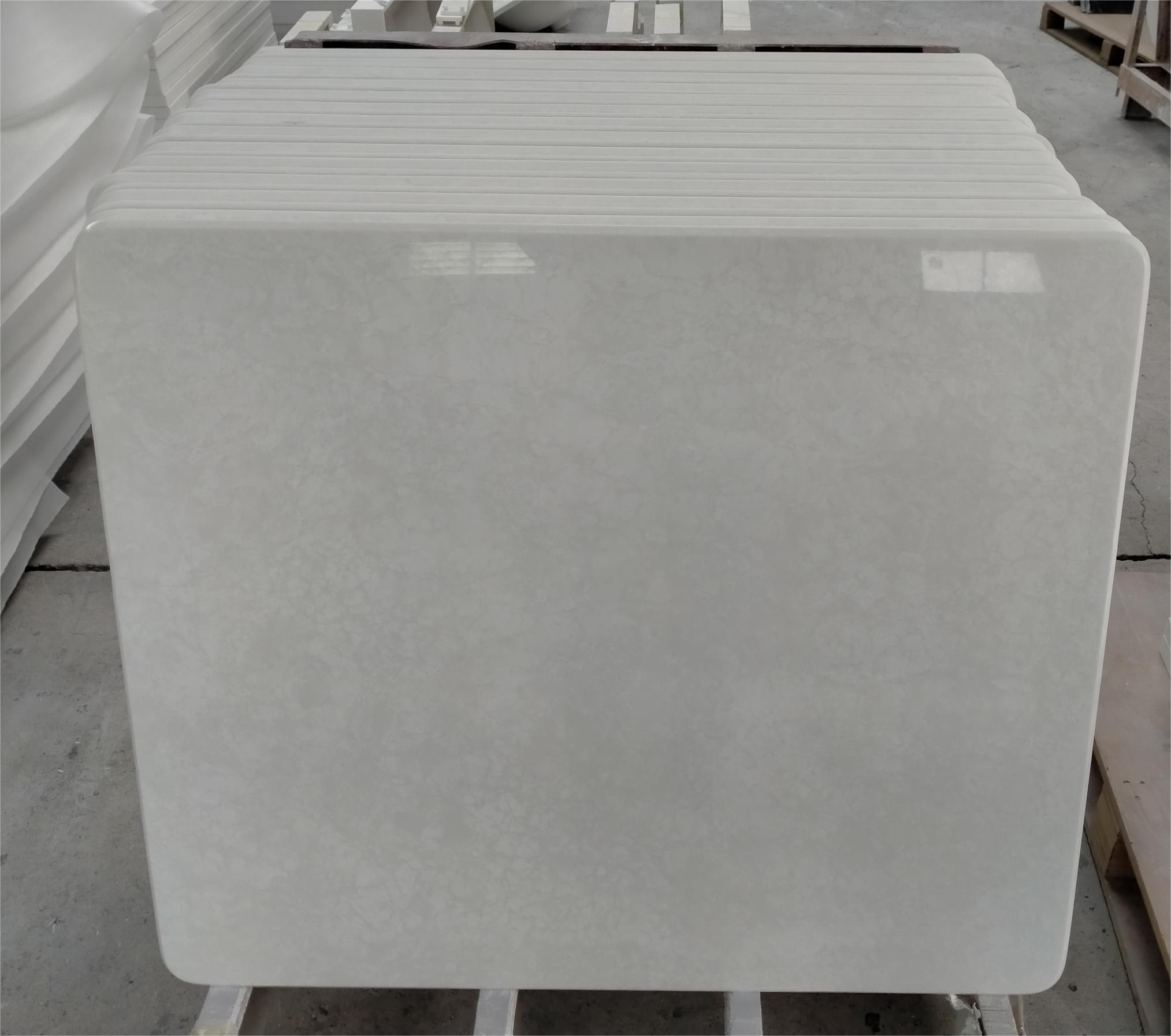

What Is Solid Surface Fabrication?
Solid surface fabrication is the process of transforming solid surface sheets into finished products through cutting, CNC machining, thermoforming, adhesive joining, edge profiling, sanding, polishing, and assembly.
Unlike conventional stone materials, acrylic solid surface can be machined, bonded, and, depending on its formulation, thermoformed into curved shapes. These characteristics make it a versatile material for both standard installations and customized architectural designs.
With the right fabrication techniques, manufacturers can create smooth transitions, inconspicuous joints, integrated components, and complex three-dimensional forms.
At ESHINE, we support the complete process from material selection and technical drawings to custom fabrication and finished-product manufacturing.
Our solutions include:
- Custom kitchen and bathroom countertops
- Integrated solid surface sinks and basins
- Reception desks and commercial counters
- Solid surface dining tables and furniture tops
- Curved architectural components
- Custom OEM/ODM solid surface products
Whether your project requires a single prototype or repeat production, understanding the fabrication process helps ensure the final product meets your design, functional, and installation requirements.
1. Material Selection and Fabrication Planning
Successful fabrication begins with choosing the appropriate solid surface material.
Different material formulations, thicknesses, colors, and decorative patterns can affect machining, thermoforming, joining, and finishing.
Pure Acrylic vs. Modified Acrylic Solid Surface
Pure Acrylic Solid Surface
Pure acrylic solid surface uses an acrylic resin system, typically combined with mineral fillers and pigments.
It is often selected for applications requiring complex fabrication, curved components, and demanding architectural finishes.
Modified Acrylic Solid Surface
Modified acrylic solid surface generally combines acrylic and polyester resin systems.
Depending on its specific formulation, it can provide a cost-effective solution for straight countertops, furniture components, and other applications with less demanding forming requirements.
The actual fabrication characteristics of both materials should be confirmed against the selected product's technical specifications.
| Ingredient | Pure acrylic | Modified acrylic |
|---|---|---|
| Aluminum hydroxide powder | 57% | 65% |
| Acrylic resin (MMA) | 40% | 12% |
| Unsaturated polyester resin (UPR) | — | 20% |
| Other ingredients (pigment, accelerant, curing agent) | 3% | 3% |
The proportions may vary by color.
Common Sheet Dimensions
ESHINE offers solid surface sheets in several sizes and thicknesses, including:
| Specification | Common Options |
|---|---|
| Standard sheet size | 3660 × 760 mm |
| Other sheet sizes | 3050 × 760 mm, 3660 × 900 mm, 2440 × 1220 mm |
| Common thickness | 6, 8, 10, 12, 15, 20 mm |
| Additional thickness | 25 and 30 mm, subject to availability |
| Material options | Pure Acrylic, Modified Acrylic, Marble Vein, Translucent, Custom Colors |
A commonly specified size is 3660 × 760 × 12 mm, suitable for a wide range of countertop and fabrication applications.
For custom projects, ESHINE can help evaluate suitable sheet dimensions, material types, and fabrication methods to reduce waste and improve production efficiency.
2. CNC Machining and Precision Cutting
CNC machining is an important stage in modern solid surface fabrication.

Computer-controlled equipment allows manufacturers to cut solid surface sheets into accurately shaped components based on CAD drawings or approved production files.
Common CNC Operations
- Straight and curved cutting
- Sink and basin cutouts
- Faucet and drainage openings
- Custom profiles and rounded corners
- Furniture component shaping
- Recesses and other architectural details
CNC machining is especially valuable for repeat production, where consistent dimensions and component alignment are essential.
For example, a commercial project involving multiple bathroom vanity tops may require consistent basin positions, faucet openings, and edge profiles across the entire order.
Accurate machining helps simplify subsequent assembly and on-site installation.
Fabrication Tip: Technical drawings should clearly indicate overall dimensions, cutout positions, corner radii, edge details, and installation tolerances before production begins.
3. Thermoforming: Creating Curved Solid Surface Designs
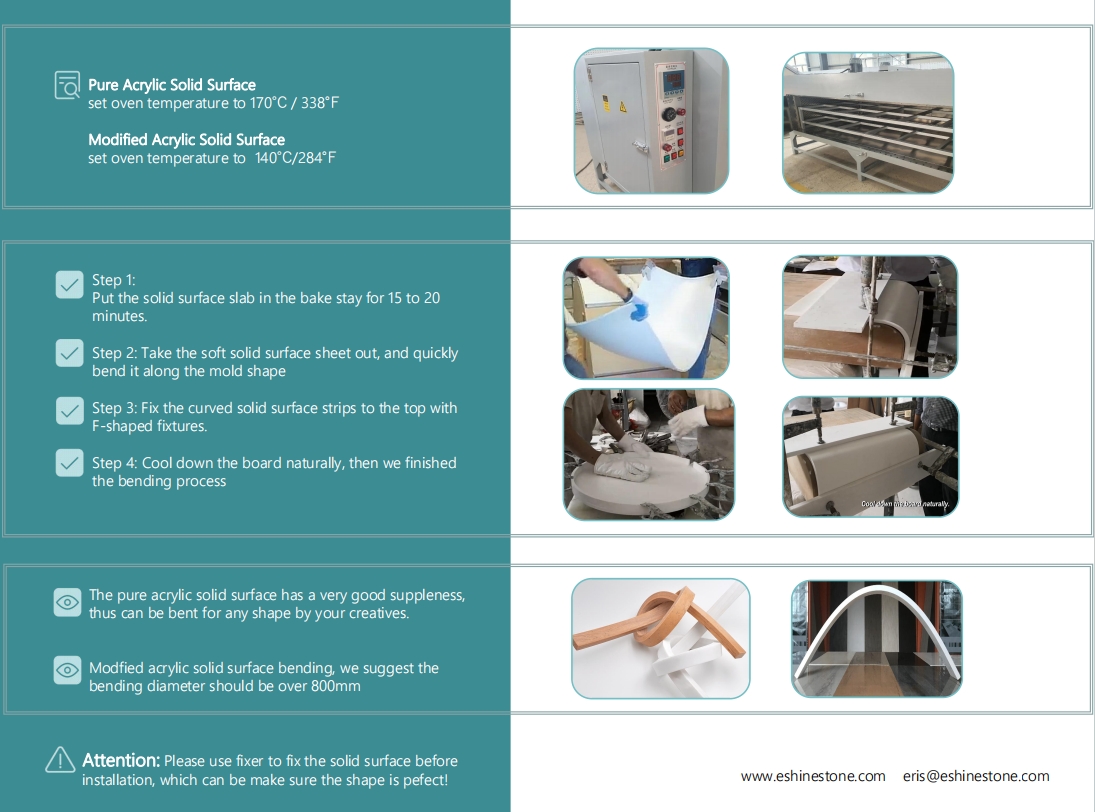
One of the distinctive advantages of suitable acrylic solid surface materials is their ability to be thermoformed.
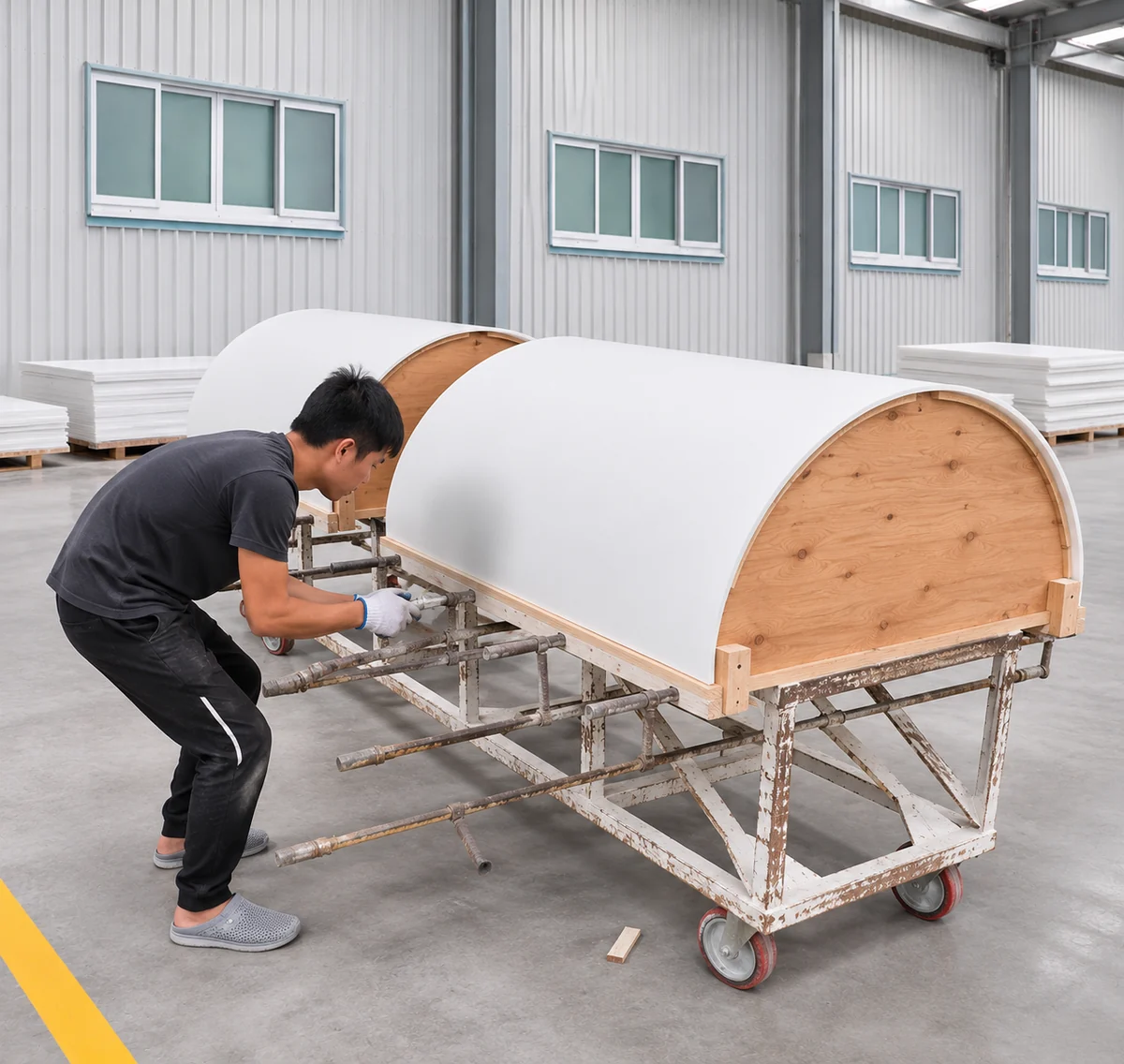
Thermoforming involves heating a solid surface sheet until it becomes sufficiently flexible, shaping it over a prepared mold, and allowing it to cool while maintaining the required geometry.
This technique opens up design possibilities that are difficult to achieve using traditional rigid materials.
Typical Thermoforming Applications
- Curved reception desks
- Rounded countertop sections
- Sculptural furniture components
- Curved wall and interior features
- Custom architectural details
The success of thermoforming depends on several factors:
Material Composition: Different acrylic and modified acrylic formulations have different forming capabilities.
Sheet Thickness: Thickness affects heating time, bending behavior, and achievable curvature.
Color and Pattern: Some heavily pigmented, veined, or particulate designs may have greater forming limitations.
Bending Radius: The minimum achievable radius depends on the exact material, thickness, mold geometry, and processing conditions.
Heating and Cooling: Uniform heating and controlled cooling help prevent defects such as cracking, deformation, or discoloration.
ESHINE can evaluate thermoforming requirements during the design stage and recommend suitable fabrication approaches.
For curved products, customers are encouraged to provide drawings showing the desired radius, dimensions, thickness, and final appearance.
Important: Thermoforming parameters must be validated for the selected material. A bending radius or processing temperature suitable for one solid surface formulation should not automatically be applied to another.
4. Seamless Joining and Adhesive Bonding
Seamless appearance is one of the main reasons designers and fabricators choose solid surface for countertops and architectural installations.

Using compatible, color-matched adhesives and proper joint preparation, separate solid surface components can be bonded into a visually continuous surface.
How Solid Surface Joining Works
A typical bonding process includes:
- Preparing accurate, clean, properly fitted joint surfaces.
- Selecting a compatible adhesive with a suitable color match.
- Applying the adhesive and bringing the components together.
- Maintaining alignment and pressure during curing.
- Removing excess adhesive and finishing the joint.
- Inspecting the completed surface for visual and structural quality.
When correctly fabricated, joints can be difficult to distinguish from the surrounding surface.
However, joint visibility varies with color, pattern, lighting, workmanship, and adhesive compatibility. Decorative veined patterns may require additional alignment planning.
Where Seamless Joining Matters
Seamless fabrication is particularly beneficial for:
- Long commercial countertops
- L-shaped and U-shaped kitchen worktops
- Hotel reception counters
- Integrated bathroom vanities
- Large custom furniture installations
Proper joint design also needs to account for support, movement, and installation conditions.
5. Edge Fabrication and Surface Finishing
Edge details have an important influence on both the appearance and usability of a finished solid surface product.
Depending on the design, edge fabrication may involve routing, shaping, laminated edge buildup, sanding, and polishing.
Common Edge Profiles
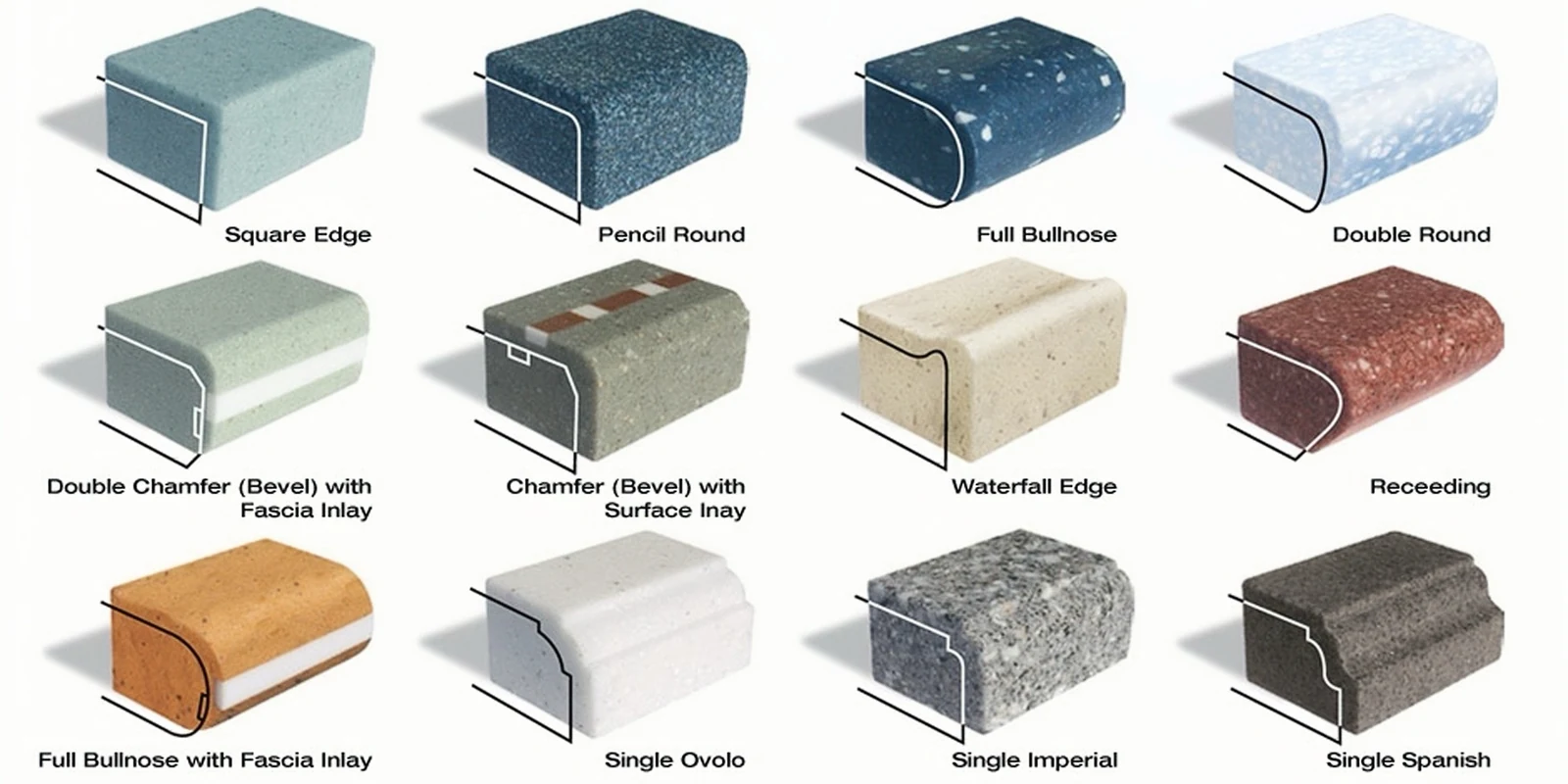
| Edge Type | Typical Application |
|---|---|
| Square Edge | Modern countertops and furniture |
| Eased Edge | Kitchens, bathrooms, commercial worktops |
| Rounded Edge | Furniture and high-contact areas |
| Bullnose Edge | Decorative countertop designs |
| Beveled Edge | Contemporary architectural details |
| Custom Profile | OEM furniture and bespoke installations |
Thicker-looking countertop edges can sometimes be created through properly engineered buildup techniques rather than requiring a full-thickness solid sheet.
Surface Finishing
Solid surface can be finished to different sheen levels, depending on the material and application:
- Matte
- Satin
- Semi-gloss
- Gloss
The final finish is achieved through controlled sanding and, where appropriate, polishing.
The selected finish should consider maintenance expectations, product color, usage conditions, and the manufacturer's recommendations.
For commercial applications, consistent finishing across multiple fabricated parts is especially important.
6. Integrated Basins and Custom Bathroom Solutions
Solid surface is widely used in bathroom applications because of its non-porous surface and ability to create visually integrated designs.

Through precision cutting, compatible bonding, and careful finishing, manufacturers can combine countertops and basins into coordinated assemblies.
Common Products
- Integrated bathroom vanity tops
- Custom washbasins
- Double-basin countertops
- Hotel bathroom countertops
- Commercial wash stations
- Custom solid surface furniture with basins
Important Design Considerations
For integrated basin projects, fabrication planning should confirm:
- Overall countertop dimensions
- Basin width, length, and depth
- Basin position and orientation
- Drainage opening and outlet compatibility
- Faucet hole requirements
- Backsplash dimensions
- Support and installation method
For custom projects, basin dimensions should be evaluated against the countertop depth and available installation space.
ESHINE supports made-to-order bathroom solutions based on approved drawings and project requirements.
7. Custom Assembly and OEM/ODM Manufacturing
Solid surface fabrication frequently extends beyond sheet processing.

Many commercial projects require multiple components to be fabricated and assembled into a complete product.
Examples include:
Reception Desks
Custom reception counters may involve curved panels, joined surfaces, internal support structures, and integration with other materials.
Solid Surface Furniture
Dining tables, coffee tables, and furniture tops may require shaped solid surface components, reinforced assemblies, and coordinated mounting systems.
Commercial Countertops
Hotels, restaurants, retail spaces, and healthcare interiors often require customized dimensions, cutouts, and installation-ready components.
Architectural Features
Custom wall features, curved elements, and decorative components may involve CNC machining, thermoforming, and multi-part assembly.
ESHINE OEM/ODM Workflow
Our approach to custom solid surface manufacturing typically follows seven stages:
- Project Consultation — Review your design, intended application, and technical requirements.
- Material Selection — Identify suitable sheet types, colors, thicknesses, and finishes.
- Drawing Review — Confirm dimensions, fabrication details, and assembly requirements.
- Prototype or Sample — Produce samples where necessary to validate the proposed solution.
- Fabrication — Carry out CNC machining, thermoforming, bonding, and finishing as required.
- Quality Inspection — Check dimensions, surface finish, joints, and approved specifications.
- Packing and Delivery — Prepare the finished components for shipment according to the agreed packaging and delivery requirements.
For overseas customers, this process helps reduce the amount of fabrication required after importation and supports more predictable project planning.
8. Quality Control in Solid Surface Fabrication
Quality control should be integrated throughout the manufacturing process, not limited to the final inspection.

Important inspection items include:
| Inspection Area | Key Checks |
|---|---|
| Raw Materials | Color, thickness, surface defects |
| Cutting | Dimensions, cutout positions, geometry |
| Thermoforming | Shape, cracks, distortion |
| Bonding | Joint alignment, adhesive cure, appearance |
| Edge Processing | Profile consistency, smoothness |
| Surface Finishing | Scratches, sanding consistency, finish |
| Final Assembly | Fit, stability, approved dimensions |
| Packaging | Surface protection and handling suitability |
For custom OEM/ODM orders, approved drawings and agreed acceptance criteria should form the basis of the inspection process.
Customers with specific documentation requirements can discuss available material composition declarations, applicable test reports, and project-specific quality documentation before placing an order.
9. What Information Should You Provide for a Custom Fabrication Quote?
A detailed inquiry allows a manufacturer to evaluate production feasibility and prepare a more accurate quotation.
Ideally, provide the following information:
- Product type and intended application
- Overall dimensions and sheet thickness
- Preferred color and material type
- 2D drawings, 3D files, or reference images
- Edge profiles, cutouts, and special shapes
- Surface finish requirements
- Estimated order quantity
- Destination country and delivery requirements
- Any applicable testing or documentation requirements
For complex designs, early technical review is recommended to identify potential manufacturing limitations before production.
Frequently Asked Questions
Can solid surface be cut into custom shapes?
Yes. Solid surface sheets can be cut and machined into various shapes using suitable CNC equipment, routers, and other fabrication tools.
Can solid surface sheets be bent?
Suitable acrylic solid surface sheets can be thermoformed into curved components. The achievable bending radius depends on the particular material, thickness, color, and processing conditions.
Are solid surface joints completely invisible?
Properly fabricated, color-matched joints can be visually inconspicuous. However, completely invisible joints cannot be guaranteed for every color, pattern, or lighting condition.
Can solid surface be used to manufacture furniture?
Yes. Solid surface can be fabricated into dining table tops, coffee table tops, reception desks, shelves, and custom furniture components. Structural support and mounting details must be considered during product design.
Can ESHINE manufacture finished products instead of only supplying sheets?
Yes. ESHINE supplies both solid surface sheets and custom fabricated products, including countertops, integrated basins, furniture components, and bespoke commercial solutions.
Does ESHINE support small-quantity custom projects?
ESHINE supports custom project inquiries, including single-piece projects where manufacturing feasibility allows. Minimum order quantities depend on the material, design, and fabrication requirements.
From Concept to Realization — Custom Solid Surface Manufacturing with ESHINE
Solid surface fabrication transforms a versatile sheet material into functional products designed for real spaces.
From CNC cutting and thermoforming to seamless joining, precision finishing, and final assembly, each stage contributes to the appearance, performance, and suitability of the finished product.
ESHINE helps international buyers, architects, designers, contractors, and furniture manufacturers turn their concepts into custom solid surface products.
Whether you are sourcing standard solid surface sheets or developing a fully customized OEM/ODM product, our team can help you evaluate materials, fabrication feasibility, and manufacturing options.
Have a custom solid surface project?
Send us your drawings, dimensions, preferred materials, and quantity requirements to discuss a tailored manufacturing solution.